
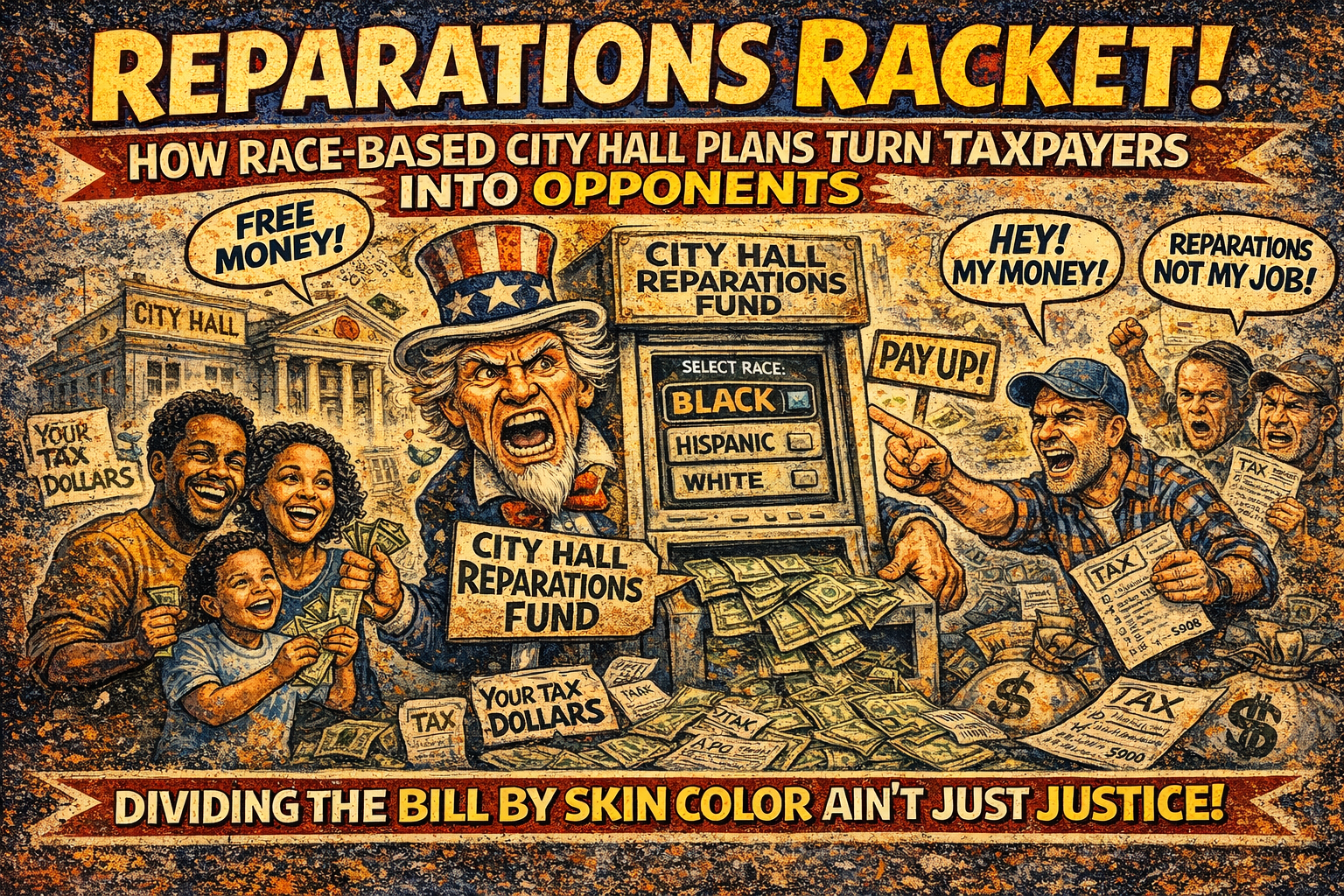
There was a time when city government wasted your money in the normal American way. A consultant report nobody read. A “community engagement” meeting attended by six retirees and one guy who thought it was a zoning hearing. A mural that looked like a forklift crash with feelings. Fine. Dumb, but familiar.
Now the new civic fashion is even worse. Cities like Evanston, Illinois have decided the hottest new use for public power is sorting residents by race, handing out benefits accordingly, and calling the whole thing moral progress. Terrific. Just tremendous. Nothing says “bringing people together” like teaching neighbors to stare at each other through a tax-funded racial peephole.
This is the scam at the heart of the modern reparations push in local government. It is sold as healing. It is marketed as justice. It is framed as a brave reckoning. But once you scrape off the therapeutic perfume and nonprofit buzzwords, what you are left with is government using money taken from the public to divide citizens by race and reward one category over another. That is not unity. That is city hall running a civic food fight with your wallet.
The Evanston Experiment: Separate Buckets, Same Taxpayers
Evanston became the poster child for this whole racket because it openly built a local reparations program around race-based eligibility. The city’s own records show its restorative housing program was funded through the local reparations fund, and that the city had already committed the first $10 million of its municipal cannabis tax revenue to local reparations for Black residents tied to housing and economic development programs. That is not hidden in the attic. It is right there in the city’s own documents. See the city’s official program page and the adopted local guidelines and resolutions in Evanston’s official document center.
And there it is. The whole trick. Take public revenue, put a moral halo over it, then distribute benefits according to race while insisting everybody else is too uncultured to understand the sophistication of being officially categorized by government. It is the kind of thing that would have caused a national nervous breakdown if it were aimed in any other direction, but because the right people in the right zip codes call it equity, suddenly the same crowd that once screamed about colorblindness acts like racial sorting is a sign of enlightenment.
No, it is a sign that the people in charge have run out of real ideas.
Race-Centered Government Does Not Heal Old Divides. It Manufactures New Ones
This is what the cardigan class never wants to admit. Once government starts distributing benefits based on race, it is no longer acting as a neutral institution serving the public. It is acting like a referee who wandered onto the field, picked one team, and then billed the crowd for the whistle.
That kind of government does not calm a city down. It does not make residents trust each other more. It does not encourage common identity. It trains people to see public life as a racial spoils system. It tells one citizen, “You qualify because of who your group is,” and tells another, “Keep paying and shut up, this is historic.”
Great system. Very healthy. Definitely the sort of arrangement that produces social peace instead of a low-boil resentment machine humming in the background of every local election.
And that is before you even get to the obvious question city hall never wants asked out loud: if race is now an acceptable basis for deciding who gets special access to public benefit, where exactly does that logic stop? At one program? One city? One favored narrative? Of course not. Once the principle is accepted, every grievance lobby in America starts lining up with a clipboard and a dream.
The Copycats Keep Coming Because the Politics Are Addictive
Evanston did not stay a one-off curiosity. It became a model, a symbol, and a permission slip. In California, the reparations debate ballooned into a statewide policy project, with lawmakers and the governor advancing some measures while backing away from others once the legal and financial reality started to stink up the room. CalMatters reported in 2025 that Governor Gavin Newsom signed five reparations-related laws while vetoing five others, which is political code for, “We like the applause, but some of this may actually be radioactive.”
In San Francisco, the city’s reparations process became a national punchline after proposals included a $5 million payment to eligible Black adults, along with other fantastical add-ons that sounded less like public policy and more like a guy at the end of the bar designing a utopia on a cocktail napkin. Then in 2024, the city formally apologized to Black residents and descendants for decades of discriminatory policy, while the larger proposals still floated around like a hot-air balloon full of other people’s money. That is not made up. That is straight from Associated Press reporting on San Francisco’s apology and reparations debate.
Tulsa has moved through its own “road to repair” framework tied to the legacy of the 1921 massacre, including proposals for major targeted investments and benefits. Reuters reported in 2025 that Tulsa’s mayor backed major components of a new reparations plan. Different city, different history, same basic political habit: turn government into an ancestry accountant and pretend that selective payout politics is the same thing as civic virtue.
Tax Dollars Are Not Magic Just Because Activists Like the Receipt
One of the cheapest tricks in this whole debate is pretending that some revenue streams do not count as public money if activists happen to enjoy the branding. In Evanston, defenders love pointing to cannabis taxes as if that changes the underlying principle. It does not. Tax money is tax money. Once the government collects it, controls it, and allocates it, it becomes a public choice about who matters and who does not.
You do not get to run a race-based public program and then wave your hands around because the money came from a trendy sin tax instead of a boring property tax. That is like robbing the front register and then explaining that it is fine because you left the tip jar alone.
Meanwhile, cities still have roads, schools, emergency services, housing shortages, crime, failing infrastructure, and all the normal obligations of actual governance. But instead of solving universal problems in universal ways, a lot of local politicians would rather cosplay as miniature national redeemers. It is easier to sort people into moral categories than to build something that works for everyone.
This Is Not Repair. It Is Bureaucratic Race Hustling
Let us drop the fake incense for a minute. These programs are not bold because they are effective. They are bold because they are theatrical. They let city officials, activists, and nonprofit sermonizers perform righteousness with public money while avoiding the far harder job of creating policies based on need, merit, and equal treatment under law.
That is the part they hate. Equal treatment is boring. Equal treatment does not let you hold a press conference where everybody nods solemnly and pretends they are starring in a PBS documentary about moral courage. Equal treatment does not let local politicians cosplay as national saviors. Equal treatment just says the obvious thing: government should serve citizens as citizens, not carve them into racial inventory and start moving benefits around like a crooked pit boss.
And yes, history matters. Yes, past injustice matters. Yes, bad policy has had long tails. But the answer to that is not building a new system of official racial preference at the local level and expecting everybody else to call it noble. You do not cure obsession with race by making race the center of public distribution. You do not reduce division by installing it in the budget.
The Real Result: More Suspicion, More Resentment, Less Country
That is the real damage done by these schemes. They do not just burn money. They burn trust. They teach residents that public life is no longer about shared citizenship, shared rules, and shared obligation. It is about who can best frame themselves as historically billable and politically untouchable.
Once that becomes the operating logic, every city turns into a grievance bazaar. Every program becomes a fight over identity. Every taxpayer becomes a mark. And every official involved gets to act like a visionary while the public is forced to absorb the social cost of government deciding that race is once again the proper lens for handing out benefits.
That is not progress. That is regression with a DEI label maker and a nicer website.
Final Flush
Evanston and the cities chasing this model are not pioneering the future. They are reviving one of the oldest and dumbest habits in politics: dividing people by race, dressing it up as virtue, and sending the bill to everybody else.
This is a failed race-centered experiment. It uses tax dollars to divide citizens by ancestry, reward political favorites by identity, and replace common civic life with a permanent argument over who owes whom forever. It does not heal. It does not unify. It does not solve the actual municipal problems crushing ordinary people. It just gives city hall one more excuse to act like a moral vending machine while the rest of the town gets stuck paying for the electricity.
Government should fix what is broken for everyone. The minute it starts sorting the public by race and redistributing benefits on that basis, it stops being a common institution and starts becoming a weaponized grievance dispenser.
No thanks. Flush it.
XoXo💩💩
Leave a Reply