
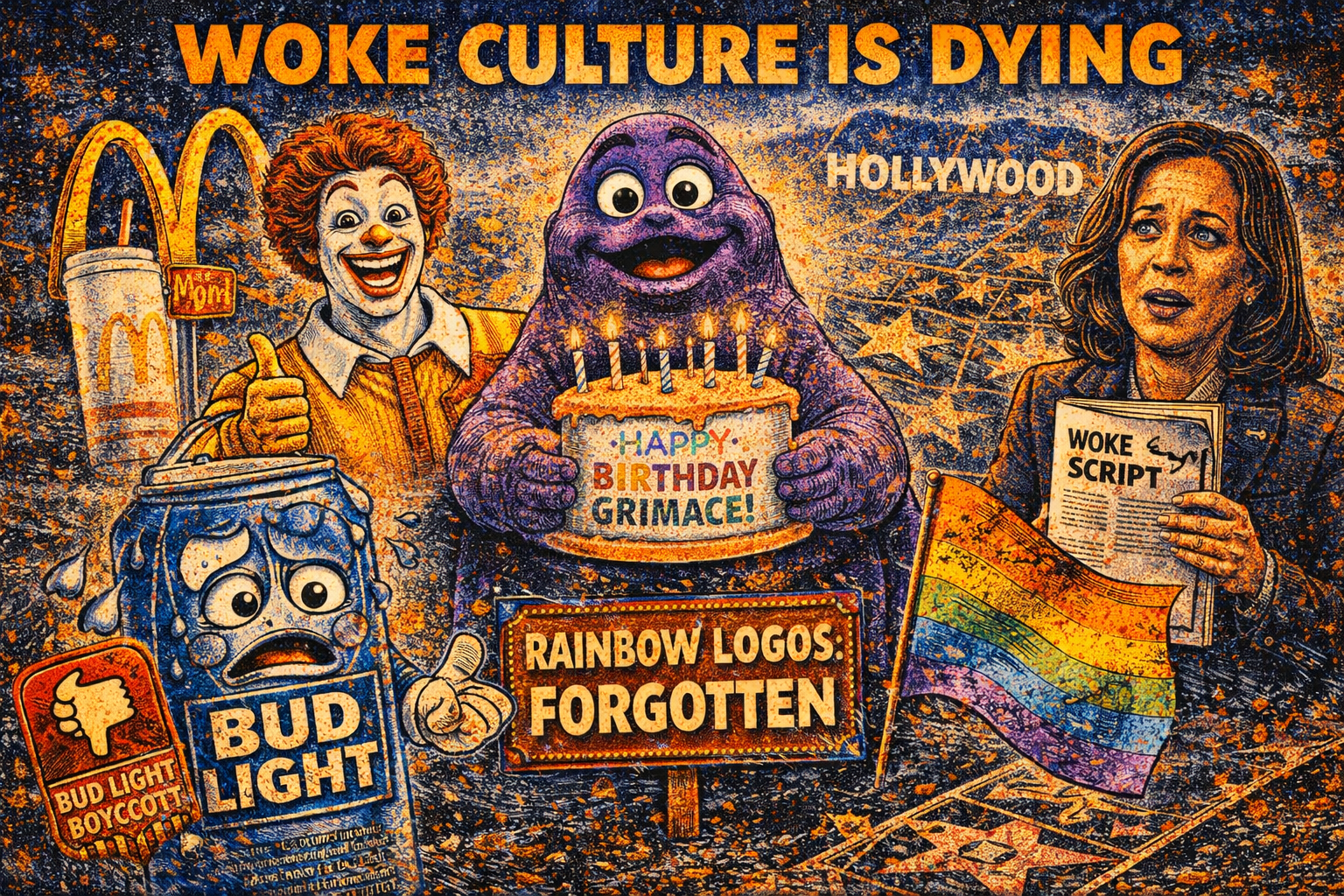
From Hashtags to “Actually, Let’s Talk About Grimace”
There was a time, not that long ago, when corporate America treated “woke” messaging like it was oxygen. Every logo turned into a rainbow. Every brand suddenly discovered a deep, emotional commitment to causes they had not mentioned since last June.
And now?
Now McDonald’s is out here celebrating Grimace’s birthday like it just rediscovered birthday parties for the first time.
That is not a coincidence. That is a pivot.
The Rainbow Logos Quietly Disappear
Remember when every major corporation changed its logo the second the calendar flipped to June?
Tech companies. Retail giants. Fast food chains. Even brands that sell things nobody associates with activism suddenly had a deep need to express themselves through color gradients.
Now the rainbow rollout is looking a little… selective.
Some companies are dialing it back. Others are skipping it entirely. And a few are acting like it never happened in the first place.
It turns out, when customers start noticing that your activism disappears the second it becomes inconvenient, they start asking uncomfortable questions.
Bud Light: The Case Study Nobody Wants to Be
If woke corporate marketing had a “before and after” picture, it would be Bud Light.
The Dylan Mulvaney campaign was supposed to be another safe, applause-line moment. A quick brand alignment with a trending cultural narrative.
Instead, it turned into one of the most brutal consumer backlashes in recent memory.
Sales dropped. Market share took a hit. The brand went from ubiquitous to cautionary tale almost overnight.
And now?
Now Bud Light is scrambling to claw back the audience it pushed away, rolling out campaigns that feel less like bold statements and more like a company nervously checking if anyone is still willing to show up.
Slacktivism Hits the Wall
Corporate “activism” was never about sacrifice. It was about alignment.
As long as the cultural winds were blowing in one direction, companies followed along. It was easy. It was safe. It looked good in a press release.
But the second customers started pushing back, that same energy disappeared faster than a limited-time menu item.
Turns out, most corporations are not interested in being activists. They are interested in being profitable.
And when activism starts hurting the bottom line, it gets quietly rebranded as something else.
Hollywood: The Last Holdout in a Time Capsule
If corporate America is moving on, Hollywood did not get the memo.
Studios are still pushing content that feels like it was greenlit under the assumption that a Kamala Harris presidency was a guaranteed outcome and the cultural direction was locked in.
Because, in many cases, it was.
Movies and shows being released now were written, funded, and produced during a period when the industry assumed the Biden-Era cultural framework was permanent.
Now those projects are hitting an audience that is clearly less interested, less patient, and a lot more skeptical.
The result?
Box office struggles. Audience fatigue. And a growing sense that Hollywood is arguing with a version of the country that no longer exists in the same way.
The DoDo Storm Take
Woke culture did not collapse overnight. It just stopped being useful.
McDonald’s did not suddenly become anti-anything. It just realized people like Grimace more than they like being lectured by a burger chain.
Companies did not lose their values. They remembered their actual value is making money.
And Bud Light?
Bud Light learned the hard way that customers are not props in a marketing campaign.
The only place still acting like nothing has changed is Hollywood, where the scripts were written for an audience that has already moved on.
Corporate America is not leading culture anymore. It is reacting to it.
And right now, the reaction is pretty clear.
Less preaching. More products. And apparently, a whole lot more Grimace.
XoXo💩💩
Leave a Reply